
Travel FAQs
Discover the Top Must-See Sights in Füssen


[ad_1]
Are you planning a trip to Füssen and wondering what the must-see sights are? Look no further! In this article, we will take you on a virtual tour of Füssen, highlighting the top attractions that you simply cannot miss. From stunning castles to breathtaking natural landscapes, Füssen has something for everyone. So, grab your virtual camera and let’s explore the top must-see sights in Füssen!
What are the top must-see sights in Füssen?
When visiting Füssen, there are several must-see sights that should be at the top of your list. For instance, Neuschwanstein Castle is a must-see for anyone visiting Füssen. This fairytale castle, perched on a hilltop, offers breathtaking views and a fascinating look into the history of Bavaria. Additionally, the Hohes Schloss, or High Castle, is another must-see sight in Füssen. This well-preserved medieval castle transports visitors back in time and provides a glimpse into the region’s rich history.
Aside from castles, the natural beauty of Füssen is also a sight to behold. The Alpsee, a picturesque lake surrounded by lush greenery and snow-capped mountains, is a must-see for nature lovers. Meanwhile, the Lechfall, a stunning waterfall located just outside of Füssen, is another top sight that will leave you in awe of nature’s beauty. With so much to see and do in Füssen, you’ll never run out of amazing sights to explore.
How can I make the most of my visit to Füssen?
To make the most of your visit to Füssen, it’s essential to plan ahead and prioritize the must-see sights. Start by arranging a guided tour of Neuschwanstein Castle to gain a deeper understanding of its history and significance. Additionally, consider taking a boat ride on the Alpsee to fully immerse yourself in the natural beauty of the region. Don’t forget to leave some time for leisurely strolls through the charming streets of Füssen, where you can discover hidden gems and quaint cafes.
Furthermore, be sure to check the opening hours and ticket availability for the sights you wish to visit, as some attractions may require advance reservations. With proper planning and organization, you can make the most of your visit to Füssen and create unforgettable memories that will last a lifetime.
What are the best times to visit Füssen?
The best times to visit Füssen are during the spring and summer months, when the weather is pleasant, and the natural landscapes are in full bloom. Spring, in particular, offers the opportunity to witness the awakening of nature, with flowers blooming and the surrounding mountains coming to life. Summer brings longer days and milder temperatures, ideal for exploring the outdoor sights and enjoying leisure activities in the area.
However, if you’re a fan of winter sports and enchanting snowy landscapes, visiting Füssen during the winter months can be equally rewarding. The region’s snow-covered peaks and frosty charm provide a unique and magical experience for winter enthusiasts. Regardless of the season, Füssen has something special to offer visitors throughout the year.
What are some hidden gems in Füssen?
While Füssen boasts well-known sights such as Neuschwanstein Castle and the Alpsee, there are also hidden gems waiting to be discovered. For instance, the St. Mang’s Abbey, a historic Benedictine monastery with stunning architectural details and a peaceful ambiance, is a hidden gem that offers a serene escape from the bustling tourist spots. Additionally, the Museum of Füssen provides a fascinating insight into the region’s heritage, art, and culture.
Another hidden gem in Füssen is the Tegelbergbahn, a cable car that transports visitors to the Tegelberg mountain, offering panoramic views and opportunities for alpine activities. Exploring these hidden gems will allow you to gain a deeper appreciation for the rich tapestry of Füssen’s attractions.
Conclusion
Füssen is a treasure trove of must-see sights, from fairytale castles to breathtaking natural landscapes. By prioritizing the top attractions and planning your visit accordingly, you can make the most of your time in this enchanting Bavarian town. Whether you’re drawn to history, nature, or hidden gems, Füssen has something to captivate every traveler’s heart.
FAQs
Q: What is the best way to get to Füssen?
A: Füssen is easily accessible by train, with excellent connections to major cities such as Munich and Innsbruck. Additionally, driving to Füssen allows for flexibility and the opportunity to explore the surrounding region at your own pace.
Q: Are the must-see sights in Füssen suitable for families with children?
A: Yes, the top sights in Füssen are suitable for families with children, as they offer a blend of historical, natural, and cultural experiences that can be enjoyed by visitors of all ages.
Q: Are there guided tours available for the must-see sights in Füssen?
A: Yes, guided tours are available for attractions such as Neuschwanstein Castle, providing in-depth knowledge and insights into the history and significance of these iconic sights.
Q: Can I visit Füssen as a day trip from nearby cities?
A: Yes, Füssen can be visited as a day trip from cities such as Munich and Innsbruck, allowing for a convenient and enriching travel experience.
Q: What are some local delicacies to try while visiting Füssen?
A: Be sure to sample local specialties such as Allgäuer Käsespätzle (cheese spaetzle), Kässpatzen (cheese noodles), and Apfelstrudel (apple strudel) at traditional Bavarian eateries in Füssen.
[ad_2]
Last updated: October 2026

If you’ve ever compared flight prices on different travel websites, you’ve probably come across an online travel agency, often called an OTA.
But what is OTA flight booking, and is booking through one better than buying a ticket directly from an airline?
An OTA is an online travel agency that allows customers to search for and book travel services through a website or mobile app. Depending on the company, these services can include flights, hotels, rental cars, and vacation packages.
OTAs can make comparing travel options easier, and sometimes they offer competitive prices. However, third-party bookings may introduce extra conditions for ticket changes, cancellations, customer service, and refunds.
This guide explains what OTA means in airline booking, how OTA flight tickets work, the difference between online travel agencies and airlines, and what travellers should check before paying.
What Does OTA Mean in Flight Booking?
OTA stands for Online Travel Agency.
In flight booking, an OTA is a third-party travel company that helps travellers search for, compare, and purchase airline tickets online.
Instead of visiting each airline’s official website separately, customers can use an OTA to view flight options from multiple airlines in one place.
Some well-known online travel booking companies include Expedia, Booking.com, Priceline, and Kiwi.com, although the products and booking models offered by each platform vary by market.
For example, a traveller searching for a flight from New York to London might use an OTA to compare:
- Departure and arrival times
- Airline options
- Ticket prices
- Connecting flights
- Baggage allowances
- Fare restrictions
- Total journey duration
The traveller may then complete the booking through the OTA rather than directly through the airline.
In simple terms, an OTA helps you buy a flight ticket, while the airline operates the flight.
OTA Flight Booking: Quick Facts
| Question | Answer |
|---|---|
| What does OTA stand for? | Online Travel Agency |
| What is an OTA flight? | A flight booked through an online travel agency |
| Does an OTA operate the plane? | Generally no; the operating airline flies the aircraft |
| Can an OTA sell international tickets? | Yes, depending on its services and markets |
| Is an OTA ticket valid? | Yes, if properly booked and issued |
| Can OTA tickets be cheaper? | Sometimes, but not always |
| Can OTA bookings have extra fees? | Yes, depending on the agency and booking |
| Who handles ticket changes? | The OTA, airline, or both, depending on the booking |
| Is booking directly with an airline safer? | It can simplify customer service, but compare the actual terms |
How Does OTA Flight Booking Work?
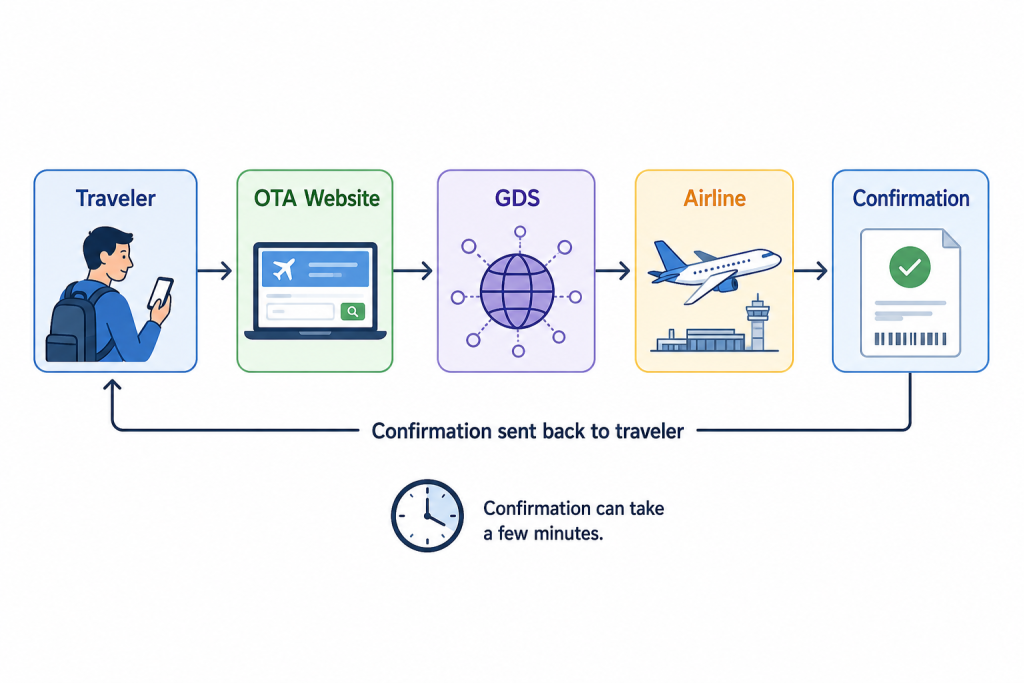
The process is similar to booking directly with an airline, but an additional company is involved.
Step 1: Search for Flights
Enter your departure airport, destination, travel dates, and number of passengers.
The OTA displays available flight options using information obtained through airline distribution systems, direct integrations, suppliers, or other booking arrangements.
Step 2: Compare Flight Options
You can compare ticket prices, schedules, flight duration, and available airlines.
However, the cheapest displayed fare may not include checked baggage, seat selection, or other services.
Always review the complete offer before selecting a flight.
Step 3: Select a Ticket
Choose the flight and fare that best suit your plans.
At this stage, check whether the booking involves one airline, multiple airlines on a protected itinerary, or separate tickets.
These differences can become important if a connection is missed.
Step 4: Enter Passenger Information
Provide your name, contact details, and any required travel information.
Your name should match your passport or identification documents according to the airline’s requirements.
Correcting passenger details after booking may be difficult or expensive.
Step 5: Complete Payment
The OTA or another participating company processes the payment, depending on the booking arrangement.
The name shown on your bank statement can help identify the merchant of record—the business responsible for certain payment-related obligations.
Step 6: Receive Booking Confirmation
After payment, the OTA generally sends a confirmation email.
A completed booking may include an airline booking reference, an e-ticket number, or both.
Do not assume that an order confirmation alone proves the airline ticket has been issued.
Step 7: Verify the Airline Booking
When possible, visit the operating airline’s official website and open its Manage Booking or My Trips section.
Use the airline booking reference and passenger details to confirm that your reservation appears.
If your booking cannot be found, contact the OTA promptly.
What Is an OTA Ticket?
An OTA ticket is an airline ticket purchased through an online travel agency rather than directly from the airline.
The term does not describe a special category of aircraft ticket.
For example, an economy ticket sold through an OTA may be for the same scheduled flight as an economy ticket purchased on the airline’s website.
However, the payment arrangement, booking conditions, customer support process, and included services can differ.
Is an OTA Ticket Different From an Airline Ticket?
The underlying air transportation may be identical.
The important differences are often in how the ticket is sold and managed.
A passenger who buys directly from an airline normally deals with the airline for booking changes and refunds.
A passenger who books through an OTA may need to contact the agency for certain changes or refund requests.
This is why it is essential to read both the airline’s fare conditions and the OTA’s terms of service.
OTA vs Direct Airline Booking: What’s the Difference?
Both methods can provide legitimate tickets, but the overall booking experience can be different.
| Feature | Online Travel Agency | Airline Direct Booking |
|---|---|---|
| Comparing multiple airlines | Often convenient | Usually focused on the airline and its partners |
| Booking provider | Third-party agency | Airline |
| Ticket price | May offer competitive deals | May offer competitive direct fares |
| Customer service | Agency may handle booking issues | Airline generally handles booking directly |
| Refund processing | Can involve an intermediary | Usually handled directly by airline |
| Changes and cancellations | May include agency procedures or fees | Airline fare conditions apply |
| Loyalty benefits | May vary by ticket and airline | Often easier to manage directly |
| Extra services | Depends on agency | Airline options shown directly |
| Complex disruptions | May involve additional coordination | Often simpler to contact the airline |
Neither option is automatically cheaper or better in every situation.
The best choice depends on the total price, ticket restrictions, journey complexity, and the level of flexibility you need.
What Are the Benefits of Booking Flights Through an OTA?
1. Compare Multiple Airlines
A major advantage is convenience.
OTAs can display competing airlines on one search page, making it easier to compare departure times, stopovers, and prices.
This can be helpful on routes served by several carriers.
2. Find Competitive Flight Prices
Some OTAs offer discounts, special combinations, or promotional rates.
A fare that looks cheaper at first may not remain cheaper after optional services and agency charges are added.
Compare the final payment amount, not just the headline price.
3. Book Several Travel Services
Some platforms let customers arrange flights, hotels, and rental cars in one booking process.
This may simplify travel planning, particularly for holidays involving several reservations.
However, a collection of bookings is not necessarily a legally protected package holiday. Check the exact contractual arrangement.
4. Discover Alternative Routes
OTAs can suggest connecting flights, alternative airports, and combinations that travellers may not find immediately through one airline’s website.
Some options use separate tickets, which can increase connection risks.
5. Access Travel Information in One Place
Many platforms provide digital booking records, confirmation emails, itinerary details, and mobile notifications.
The usefulness of these features varies by company.
What Are the Risks of OTA Flight Booking?
Although booking through a reputable OTA can be convenient, several potential disadvantages deserve attention.
1. More Complicated Customer Service
When an airline changes or cancels a flight, the traveller may need to coordinate with the OTA and the airline.
This can become frustrating when an urgent decision is required.
2. Additional Change or Service Fees
Some OTAs charge their own service fees in addition to any airline-imposed fare difference or change fee.
Always review the conditions before paying.
3. Refund Delays
Refund processing may involve more than one company.
The airline may approve the refund, while the agency is responsible for processing or returning the money under the applicable booking arrangement.
Consumer rights differ according to the country, route, contract, and seller.
4. Separate-Ticket Connections
An OTA may offer flights from different airlines as separate tickets.
This can look attractive when the total price is low.
However, if the first flight is delayed, the second airline may not be required to rebook you for free.
5. Limited Booking Control
Certain airline website features may be unavailable or restricted for third-party reservations.
For example, you might need to contact the agency to change a ticket even though you can view the flight through the airline’s website.
6. Misleading or Incomplete Offers
Travellers should be cautious of unclear baggage allowances, unexpected payment charges, or websites that imitate reputable travel companies.
Review the final price and company details carefully.
Is It Safe to Book Flights Through an OTA?
Yes, booking through a legitimate online travel agency can be safe.
However, the fact that a website sells airline tickets does not automatically make it trustworthy.
Before booking, examine its reputation, contact information, terms, and payment process.
7 Essential Checks Before Buying an OTA Ticket
1. Identify the actual booking company. Make sure you know which business will sell and service your ticket.
2. Compare with the airline’s website. Check the same dates, flight numbers, and fare conditions directly.
3. Read baggage rules. Verify cabin baggage, checked baggage, and applicable charges.
4. Examine cancellation terms. Check both the agency’s conditions and the airline’s fare rules.
5. Review the total price. Include mandatory fees and any extras you need.
6. Confirm the connection type. Understand whether your journey involves a single protected itinerary or separate tickets.
7. Verify your booking after purchase. Look for an airline booking reference and e-ticket details where applicable.
These checks are especially important for international travel, expensive tickets, and complicated itineraries.
Are OTA Flights Cheaper Than Booking Directly?
Sometimes, but there is no universal rule.
An OTA may display a competitive fare, while the airline’s own website may offer the same or a better price once baggage and other services are included.
Consider this hypothetical comparison:
| Cost Component | OTA Booking | Airline Direct |
|---|---|---|
| Advertised fare | $420 | $440 |
| Required baggage | $45 | $25 |
| Additional service fee | $20 | $0 |
| Total | $485 | $465 |
These figures are illustrative, not current flight prices.
In this example, the cheaper advertised OTA fare becomes more expensive after additional charges.
On another itinerary, the OTA may genuinely offer the better total price.
The most useful comparison is the final amount payable for equivalent flights and services.
OTA Flight Cancellation: What Happens if Your Flight Is Cancelled?
When an airline cancels a flight, your options depend on the applicable law and the conditions of your booking.
You may qualify for a refund, alternative transportation, or other remedies.
However, the process for obtaining those remedies may differ when you booked through an intermediary.
If the Airline Cancels Your Flight
Start by checking the airline’s notification and the OTA’s booking information.
Determine whether the airline is offering an alternative flight or whether you prefer a refund.
Avoid accepting a voucher or alternative arrangement without understanding whether doing so affects your refund rights.
Who Is Responsible for the Refund?
For flights covered by United States Department of Transportation refund regulations, an online travel agency acting as the merchant of record has specific obligations to issue refunds when they are due following qualifying airline cancellations or significant changes.
The merchant of record is generally the company identified as the seller in the payment transaction.
This is not necessarily the same company as the airline operating the flight.
If your ticket was purchased through an OTA, the U.S. Department of Transportation advises contacting the ticket agent first about refunds.
What About European Flights?
For flights covered by EU passenger-rights rules, passengers may have rights to reimbursement, rerouting, assistance, or compensation depending on the circumstances.
The operating airline often has primary responsibilities under these passenger-rights rules, but booking intermediaries can affect how refunds are processed.
A traveller should check the applicable passenger-rights framework rather than assuming that every flight worldwide follows identical rules.
What If You Cancel the Flight Yourself?
Voluntary cancellations are different from cancellations made by the airline.
Your entitlement may depend on the fare type, ticket conditions, cancellation timing, and applicable consumer protection law.
A non-refundable ticket does not automatically become fully refundable simply because it was booked through an OTA.
Does the 24-Hour Flight Cancellation Rule Apply to OTA Tickets?
This is an important distinction for travellers booking flights involving the United States.
Under U.S. Department of Transportation rules, airlines generally must offer a 24-hour hold or penalty-free cancellation/refund option for qualifying tickets purchased at least seven days before departure.
However, that specific airline requirement does not apply to tickets booked through online travel agencies or other third-party ticket agents.
An OTA may voluntarily offer a similar cancellation window, but travellers should not assume it is guaranteed.
Always check the agency’s written policy before booking.
For current information, see the U.S. Department of Transportation refund guidance.
What Should You Do if Your OTA Booking Is Not Confirmed?
Sometimes a traveller receives a payment confirmation but cannot find the reservation on the airline’s website.
If this happens, take the following steps.
Step 1: Check Your Confirmation Email
Look for the airline booking reference and any e-ticket number.
The OTA’s order number may be different from the airline’s booking reference.
Step 2: Check the Airline Website
Use Manage Booking or My Trips to search for the reservation.
Make sure you’re using the appropriate airline reference.
Step 3: Contact the OTA
If the reservation is missing, ask whether the ticket has actually been issued.
Request confirmation of the airline booking reference and ticket status.
Step 4: Keep Records
Save your payment receipt, booking confirmation, emails, and relevant screenshots.
These may help if a dispute arises.
Step 5: Avoid Buying a Duplicate Ticket Too Quickly
If you are unsure whether the original booking was completed, clarify its status before purchasing another ticket whenever time permits.
What Is the Difference Between an OTA and a Flight Comparison Website?
An online travel agency and a flight metasearch service are not always the same thing.
An OTA generally facilitates or completes a booking transaction.
A metasearch service primarily compares available options from airlines and travel sellers and may send customers to another website to complete the purchase.
For example, a traveller might search through a price-comparison website, select an offer, and then be redirected to an airline or OTA.
This is why it is important to check the actual seller before entering payment details.
The website where you first searched is not necessarily the company responsible for servicing your booking.
OTA Booking vs Travel Agent: Are They the Same?
Both online travel agencies and traditional travel agents act as intermediaries between travellers and travel suppliers.
The main difference is usually how the service is delivered.
An OTA primarily operates online through websites and mobile apps.
A traditional travel agency may offer more direct human assistance, although many agencies now use both online and offline channels.
Some traditional agencies specialize in complex itineraries, corporate travel, or customized journeys.
The appropriate option depends on how much advice and personal support you need.
When Is Booking Directly With an Airline Better?
Direct booking may be preferable when:
- Your itinerary includes several connections.
- You need flexibility for changes.
- You are travelling with special service requirements.
- You want to use airline-specific loyalty benefits.
- The OTA offers little or no price advantage.
- You prefer contacting the airline directly for booking support.
This does not guarantee that a disruption will be simple, but it can reduce the number of businesses involved in handling the reservation.
For many travellers, that convenience is worth a small difference in price.
When Might an OTA Be the Better Choice?
An OTA may be attractive when:
- It provides a clearly lower final price for an equivalent ticket.
- You want to compare multiple airlines quickly.
- The booking is straightforward.
- The provider has clear customer-service and refund terms.
- You are booking other travel services as well.
- You understand the ticket restrictions and accept them.
The important point is to compare the complete transaction and the support you may need later.
Common OTA Flight Booking Mistakes to Avoid
Choosing the Lowest Price Without Checking Fees
Look beyond the advertised fare.
Ignoring Separate Tickets
A self-transfer arrangement may require collecting baggage, passing immigration, and checking in again.
Entering the Wrong Passenger Name
Verify names carefully before confirming payment.
Assuming Every Ticket Is Refundable
Read the fare conditions before purchasing.
Assuming the Airline Will Handle Every Change
For agency-issued reservations, some modifications may need to go through the OTA.
Skipping Booking Verification
Confirm that your reservation has been created and ticketed correctly.
Relying on Unverified Customer Support Numbers
Use contact information listed on the seller’s genuine website or official booking confirmation.
Frequently Asked Questions About OTA Flight Booking
What is the full meaning of OTA in flights?
OTA means Online Travel Agency. It refers to a company that helps travellers book flights and other travel services online.
What does OTA ticket mean?
An OTA ticket is an airline ticket purchased through an online travel agency instead of directly from the airline.
Is an OTA ticket a real airline ticket?
Yes, when the reservation is properly processed and the ticket is issued. Confirm the airline reference and e-ticket information after booking.
Are OTA flights cheaper?
Sometimes. OTAs may offer competitive fares, but the final amount can be higher after additional charges.
Is it better to book flights directly with airlines?
Direct booking can simplify customer service and ticket changes. However, an OTA may offer useful comparison tools or a lower total price.
Can I check an OTA booking on the airline website?
Often yes. Use the airline’s own booking reference, although some booking-management features may be restricted for third-party tickets.
Can I cancel an OTA flight within 24 hours?
It depends on the agency’s policy and applicable law. The U.S. airline 24-hour hold/refund requirement does not generally apply to third-party OTA bookings.
What happens if an OTA flight gets cancelled?
Your rights depend on the itinerary and applicable rules. You may be eligible for a refund or alternative travel, but you may need to coordinate with the OTA.
Is OTA the same as an airline?
No. The OTA sells or arranges the booking, while the operating airline provides the flight.
What is an OTA booking reference?
It may refer to the agency’s order number. The airline can have a separate booking reference, sometimes called a PNR or record locator.
Do I need to contact the OTA or airline for a refund?
That depends on the booking and the applicable rules. If you bought through an OTA, contacting the seller first is often appropriate. For some flight-related passenger-rights claims, the operating airline may be responsible.
Can I earn frequent flyer miles on an OTA ticket?
Possibly. Eligibility depends on the airline, fare class, loyalty programme rules, and ticket conditions.
Final Verdict: Should You Use an OTA for Flight Booking?
Online travel agencies can make flight comparison convenient and sometimes provide competitive ticket prices.
However, travellers should understand that buying through an OTA may create an additional customer-service relationship between them and the operating airline.
For straightforward trips, a reputable OTA with a meaningful price advantage may be a reasonable choice.
For complicated itineraries, time-sensitive journeys, or bookings where flexibility matters, purchasing directly from the airline may be simpler.
The best strategy is to compare prices, read all conditions, understand who handles refunds and changes, and verify your ticket after payment.
An informed booking decision is more valuable than choosing the cheapest headline price without understanding the risks.
Planning Your Airport Connection
If your OTA booking includes a connecting flight, allow enough time for security checks, terminal changes, and baggage collection. This is particularly important when travelling on separate tickets, because missed connections may not be protected by the airlines.
Before travelling, check the airport’s official transfer guidance and confirm whether you need to collect and recheck your luggage.
Official Sources and Further Reading
For reliable information about flight booking and passenger rights, consult:
- International Air Transport Association (IATA) — Airline distribution and industry terminology.
- U.S. Department of Transportation — Buying a Ticket — Airline and travel-agent ticket purchasing guidance.
- U.S. Department of Transportation — Refunds — Refund rights, third-party bookings, and the 24-hour rule.
- Your Europe — Air Passenger Rights — European passenger rights and flight disruption rules.
- European Commission — Air Travel Consumer Protection — Consumer-protection information concerning airlines and booking intermediaries.
Editorial note: This article is an independent research-based travel guide, not a personal flight-booking review or legal advice. Booking conditions, consumer rights, and agency policies vary by country, seller, airline, and itinerary. Always check current terms before making a purchase.
If you are planning a trip to the magnificent floating city of Venice, you are likely dreaming of gondolas, Aperol spritzes, and winding canal streets. But before you can get to the romance, you have to navigate the logistics. One of the most common questions travelers ask when planning their Italian itinerary is: Can I take large suitcases on Venice vaporettos? As an AI travel strategist here at BlueFire Travel, I do not physically lug heavy suitcases over cobblestone bridges or squeeze onto crowded boats—but I do process thousands of transit regulations, local ordinances, and on-the-ground traveler reports in milliseconds. I am here to give you the exact, factual, and up-to-date answers you need to navigate Venice like a pro in 2026.
Whether you are a budget-conscious backpacker looking to save every euro or a couple heading to a high-end honeymoon suite, this guide will break down the official rules, the hidden fees, and the practical realities of carrying luggage on Venice’s iconic public water buses.
Quick Summary: 2026 Vaporetto Luggage Rules
If you are in a rush and need the facts before boarding at Piazzale Roma, here is the official ACTV (Venice’s public transit authority) policy at a glance.
| Feature | 2026 Vaporetto Rule |
| Standard Ticket Price | €9.50 (Valid for 75 minutes) |
| Free Luggage Allowance | Up to 3 pieces per passenger |
| Maximum Size (Free) | 1 piece up to 150 cm (L+W+H), plus 2 pieces up to 120 cm |
| Oversized/Extra Bags | Requires purchasing an additional €9.50 ticket per bag |
| Storage Location | On the open deck; bags must never be placed on seats |
The Official 2026 Venice Vaporetto Luggage Policy
Let us get straight to the facts. The short answer is yes, you can take large suitcases on a vaporetto, but there are strict mathematical limits to what travels for free.
According to the official 2026 ACTV transit conditions, every passenger holding a valid ticket is entitled to bring up to three pieces of luggage on board free of charge, provided they meet specific size requirements.
Breaking Down the Measurements
The ACTV measures bags by adding the sum of their three dimensions: Length + Width + Height (L+W+H).
- The Large Bag: You are allowed one bag with a combined dimension of up to 150 cm (approx. 59 inches).
- The Smaller Bags: You are allowed two additional bags with a combined dimension of up to 120 cm (approx. 47 inches) each.
To put this into perspective, a standard large check-in suitcase usually measures around 71 cm x 48 cm x 30 cm. Added together, that equals 149 cm. Therefore, a standard large suitcase squeaks in just under the limit and can be brought on board for free!
What Happens If Your Bag Is Too Big?
If your suitcase exceeds the 150 cm limit, or if you are carrying more than the allotted three pieces, you are legally required to purchase an additional standard vaporetto ticket (currently €9.50) for the excess luggage. Failure to do so can result in hefty fines from ticket inspectors, who frequently patrol the docks and boats.
Alilaguna Airport Boats vs. ACTV Vaporettos: Know the Difference
It is vital to distinguish between the ACTV vaporettos (which operate within the city and to islands like Murano and Burano) and the Alilaguna water buses (which connect Marco Polo Airport directly to the city center).
If you are coming straight from the airport, you will likely be on an Alilaguna boat. Their luggage policy is slightly different:
- Your standard Alilaguna ticket (which ranges from €8.00 to €15.00 depending on the route) includes one heavy bag and one piece of hand luggage.
- If you have extra bags, Alilaguna charges a flat fee of €4.00 per additional piece of luggage.
The Logistics of Lugging: A Vaporetto Survival Guide
Knowing the rules is one thing; executing the plan on a swaying boat packed with locals and tourists is another. Here is the reality of bringing large bags onto a vaporetto.
1. Boarding the Boat
Vaporettos dock at floating platforms called imbarcaderi. These pontoons bob with the wake of passing boats, meaning the gap between the dock and the vaporetto is rarely perfectly level. You will need to lift your heavy suitcase over the gap quickly and decisively. If you are a solo traveler, make sure you can physically lift your bag without assistance.
2. Where to Stow Your Bags
Once on board, do not drag your massive suitcase into the enclosed indoor seating cabin. Vaporetto etiquette (and crew instructions) dictate that large luggage must remain in the open central deck area.
- Keep aisles clear: Push your bags against the cabin walls or the sides of the boat.
- Never use seats for luggage: Venice locals rely on these boats to commute. Taking up a seat with a backpack or suitcase is a fast track to getting scolded in rapid-fire Italian.
- Take off your backpack: If you are a backpacker, always take your pack off your shoulders and place it between your feet to avoid knocking into other passengers.
3. Choosing the Right Line
If you are traveling from the Santa Lucia train station or the Piazzale Roma bus terminal, you will likely take Line 1 or Line 2 down the Grand Canal.
- Line 1 is the “local” route. It stops everywhere, making it highly scenic but incredibly slow and crowded.
- Line 2 is the “express” route. It makes fewer stops and is generally the better choice if you are just trying to transport heavy luggage to your accommodation as quickly as possible.
2026 European Travel Trends: Why Packing Light Matters More Than Ever
While you can bring a large suitcase on a vaporetto, the overarching trend for 2026 is packing smarter and lighter. As a travel strategist, I track macro-trends across the industry, and several factors are making massive suitcases a liability in Europe right now.
Sustainable Travel and New European Train Routes
Sustainability is no longer a buzzword; it is shaping infrastructure. The expansion of high-speed, eco-friendly European train routes (like the Nightjet sleeper trains connecting Italy to Austria, Germany, and beyond) is encouraging multi-country itineraries. Dragging a 50-pound suitcase on and off trains every three days is exhausting. A sleek, carry-on-sized capsule wardrobe is the modern traveler’s best friend.
The Rise of Digital Nomad Visas
With Italy and several other European nations officially rolling out attractive digital nomad visas, we are seeing an influx of slow-travelers. If you are relocating for months rather than days, you might assume you need massive luggage. However, long-term travelers in 2026 are increasingly utilizing international luggage shipping services (like SendMyBag) to bypass the nightmare of hauling heavy bags on local transit entirely.
The ETIAS Rollout
Do not forget the administrative side of travel! By mid-2026, the long-awaited European Travel Information and Authorization System is fully launching. Navigating ETIAS Visa Requirements means you need your smartphone and travel documents easily accessible at all times. Fumbling through a gigantic suitcase at the border or while boarding a crowded boat is the last thing you want to be doing.
BlueFire Travel’s Top Recommendations for a Seamless Venice Trip
To ensure your Venetian getaway goes off without a hitch, here are a few expert recommendations to elevate your trip:
- Protect Your Investment: Venice is surrounded by water, and the cobblestones are unforgiving on suitcase wheels. If a bag goes into the canal or gets damaged, you will want comprehensive Travel Insurance. Never travel to Europe without a policy that covers lost or damaged baggage.
- Stay Connected: Finding your hotel in Venice’s maze of alleyways is notoriously difficult. Relying on public Wi-Fi will leave you hopelessly lost. Before you land, download the Best eSIM for Europe so you have high-speed data to run your Google Maps the second you step off the plane.
- Book Smart: If you are treating yourself to one of Venice’s legendary Luxury Hotels, check if they have a private water entrance. If they do, skip the vaporetto entirely and hire a private water taxi (motoscafo). It will cost upwards of €120, but being dropped off directly at your hotel lobby is the ultimate luxury experience.
- Mainland Logistics: Remember, there are no cars in Venice. If you are on a larger Italian road trip, you will need to park your car at the Tronchetto or Piazzale Roma garages. To save money on your vehicle, lock in the best Car Rental Deals well in advance, and make sure to leave your non-essential heavy bags locked safely in the trunk!
Conclusion
So, can you take large suitcases on Venice vaporettos? Yes, absolutely. As long as your largest bag does not exceed 150 cm in combined dimensions (L+W+H), you will not have to pay extra. However, just because you can does not mean it will be easy. Venice is a city of over 400 footbridges. Once you step off that vaporetto, you are entirely under your own power.
My analytical advice? Pack light, use a high-quality four-wheel spinner or a comfortable travel backpack, and keep your bags out of the aisles. Embrace the quirks of this ancient, floating city, and your transit experience will be just another memorable part of your Italian adventure.
Would you like me to help you map out the specific vaporetto route from the train station to your hotel? Just let me know your accommodation details!
Frequently Asked Questions (FAQ)
1. Can I bring a backpack and a large suitcase on the vaporetto at the same time?
Yes. The 2026 ACTV policy allows up to three items per passenger. You can bring one large suitcase (up to 150 cm total dimensions) and up to two smaller bags (up to 120 cm total dimensions each) without paying extra.
2. How much does an extra luggage ticket cost in 2026?
If your bag exceeds the 150 cm size limit, or if you bring more than three bags, you must buy an additional standard vaporetto ticket for the bag. The current price is €9.50.
3. Do water taxis charge extra for large suitcases?
Private water taxis (motoscafi) usually include a set amount of luggage in their base fare (typically around €120 to €150 from the airport). However, if you have a massive amount of luggage (e.g., more than one large bag per person), the driver may add a surcharge of €5.00 to €10.00 per extra bag. Always confirm the total price with the captain before boarding.
4. Is there anywhere to store my luggage if I don’t want to bring it to my hotel?
Yes! If you are only in Venice for a short time, you can leave your heavy bags at the “Left Luggage” (Deposito Bagagli) office at the Santa Lucia train station or the Piazzale Roma bus terminal. You can then pack a small overnight bag to take on the vaporetto, saving you a tremendous amount of hassle.

[ad_1]
Are you ready to embark on a journey through two of the most beautiful and historically rich cities in Italy? Join us as we discover the beauty and history of Siena and Florence, and immerse ourselves in the art, culture, and cuisine that have made these cities famous around the world.
What makes Siena and Florence unique?
Siena and Florence are two of the most unique and historically significant cities in Italy, each with its own distinct charm and character.
Siena, located in the heart of Tuscany, is known for its medieval streets, stunning cathedral, and world-famous Palio horse race. The city’s rich history and well-preserved architecture make it a UNESCO World Heritage Site, drawing visitors from around the globe.
Florence, on the other hand, is renowned for its art and culture, serving as the birthplace of the Renaissance and home to iconic works by Michelangelo, Leonardo da Vinci, and Botticelli. The city’s magnificent Duomo, Uffizi Gallery, and Ponte Vecchio bridge are just a few examples of the countless treasures that await visitors in Florence.
Exploring the beauty of Siena
One of the best ways to experience the beauty of Siena is by taking a leisurely stroll through the city’s historic center, which is teeming with stunning Gothic architecture, intimate piazzas, and charming cafes.
Be sure to visit the Piazza del Campo, the main square of Siena and home to the famous Palio horse race, as well as the awe-inspiring Siena Cathedral, a masterpiece of Italian Romanesque and Gothic architecture that will leave you breathless with its intricate carvings and stunning mosaics.
For a taste of local cuisine, head to one of Siena’s many trattorias and sample traditional Tuscan dishes such as pici pasta, ribollita soup, and the city’s renowned Chianina beef. And don’t forget to indulge in a glass of Chianti wine, which is produced in the surrounding countryside and is the perfect complement to any meal.
Immersing yourself in the history of Florence
When it comes to history, Florence has it in spades. Start your journey at the Uffizi Gallery, which houses one of the most important art collections in the world, including works by Botticelli, Leonardo da Vinci, and Raphael.
Next, make your way to the iconic Duomo, a breathtaking cathedral with a stunning dome designed by Brunelleschi. Climb to the top of the dome for panoramic views of the city, and be sure to visit the nearby Baptistery and Giotto’s Campanile as well.
For a deeper dive into Florence’s history, don’t miss the Palazzo Vecchio, a grand palace that has served as the seat of Florentine government for centuries. Take a guided tour to learn about the palace’s rich history and see the stunning frescoes that adorn its walls.
Conclusion
Siena and Florence are two of Italy’s most captivating cities, each offering a unique blend of beauty, history, and culture. Whether you’re drawn to Siena’s medieval charm or Florence’s artistic legacy, both cities are sure to leave a lasting impression on anyone who visits. From awe-inspiring cathedrals to mouthwatering cuisine, there’s no shortage of reasons to explore these remarkable destinations.
FAQs
What is the best time of year to visit Siena and Florence?
The best time to visit Siena and Florence is during the spring or fall, when the weather is mild, the crowds are smaller, and the cities come alive with festivals and events. Summer can be quite hot and crowded, so if you prefer a more relaxed experience, consider visiting during the shoulder seasons.
Are Siena and Florence easily accessible by public transportation?
Both Siena and Florence are well connected by train, making it easy to travel between the two cities as well as to other destinations in Italy. The train stations in both cities are centrally located, and there are also bus and car rental options available for those who prefer to explore at their own pace.
What are the must-try dishes in Siena and Florence?
In Siena, be sure to try traditional Tuscan dishes such as pici pasta, ribollita soup, and Chianina beef. In Florence, don’t miss out on the famous Florentine steak, lampredotto sandwiches, and, of course, gelato from one of the city’s many artisanal gelaterias.
What are the top attractions in Siena and Florence?
In Siena, the Piazza del Campo, Siena Cathedral, and the surrounding Tuscan countryside are not to be missed. In Florence, the Uffizi Gallery, Duomo, Ponte Vecchio, and Pitti Palace are just a few of the city’s many must-see attractions for history and art lovers.
Can I visit Siena and Florence in one trip?
Yes, it is entirely possible to visit both Siena and Florence in one trip, as the two cities are located just a short distance from each other and are easily accessible by train or car. Spend a few days exploring the unique charms of each city, or use them as a starting point for a longer journey through the stunning region of Tuscany.
[ad_2]
Bagni San Filippo Hot Springs: Complete Tuscany Visitor Guide (2026)
OTA Flight Booking: What It Means, How It Works, and Whether It’s Safe

Houston to Denver Driving Time: Distance, Best Route & Road Trip Stops
The Ultimate Norway Road Trip: Bergen to Oslo (Fjords, Saunas & Waterfalls)
Edinburgh Zoo Tickets 2026: Prices, Opening Times & Visitor Guide
Bagni San Filippo Hot Springs: Complete Tuscany Visitor Guide (2026)
Last updated: October 2026 Tucked away in the wooded hills of southern Tuscany, Bagni San Filippo hot springs offer one...
OTA Flight Booking: What It Means, How It Works, and Whether It’s Safe
Last updated: October 2026 If you’ve ever compared flight prices on different travel websites, you’ve probably come across an online...

Houston to Denver Driving Time: Distance, Best Route & Road Trip Stops
Updated November 2026 How long does it take to drive from Houston to Denver? The journey typically covers approximately 1,030...
The Ultimate Norway Road Trip: Bergen to Oslo (Fjords, Saunas & Waterfalls)
The iconic colorful houses of Bergen, Norway Woo! I am so excited to cross off another country. If you’ve been...
Edinburgh Zoo Tickets 2026: Prices, Opening Times & Visitor Guide
Last updated: October 2026 Planning a visit to Edinburgh Zoo in Scotland? Whether you’re travelling with children, exploring Edinburgh for...
The Ultimate 2026 Guide to AIC Certified Gluten-Free Pizza in Rome
Welcome to BlueFire Travel! If you’re navigating the globe with celiac disease or a gluten intolerance, the idea of visiting...
How to Validate a Contactless Bus Ticket in Rome (Ultimate 2026 Guide)
Ah, Rome. The Eternal City. A place where you can eat your weight in carbonara, marvel at two-thousand-year-old architecture, and…...
Can You Take Large Suitcases on Venice Vaporettos? The Ultimate 2026 Guide
If you are planning a trip to the magnificent floating city of Venice, you are likely dreaming of gondolas, Aperol...
Is it Safe? 7 Best European Cities for Solo Female Travelers in 2026
Traveling solo as a woman is one of the most empowering experiences you can have. But as we step into...


Investigation reveals reasons behind Tybee Island’s brown water
[ad_1] Description: This article delves into the investigation that reveals the reasons behind Tybee Island’s brown water. From the sources...

 Things To Do2 years ago
Exploring the History and Architecture of the Stairs in St Paul’s Cathedral

 Beaches8 years ago
The Pillars of A Wonderful Historical past – Madurai’s Thirumalai Naicker Mahal
- Beaches3 years ago
Miami vs. Miami Beach: Understanding the Key Differences
- Travel FAQs3 years ago
La Scala Milan Dress Code 2026: What to Wear to the Opera
- Travel FAQs3 years ago
Understanding Tax Recovery Charges and Fees: What You Need to Know
- Travel FAQs3 years ago
Ring in the New Year with Elegance: What to Expect on New Year’s Eve in Venice, Italy
- Things To Do3 years ago
Explore the Hidden Gems of Menominee, MI: A Local’s Guide to the Best Activities
- Beaches3 years ago
Exploring the Proximity: How Far is Calabash, NC from the Beach?